
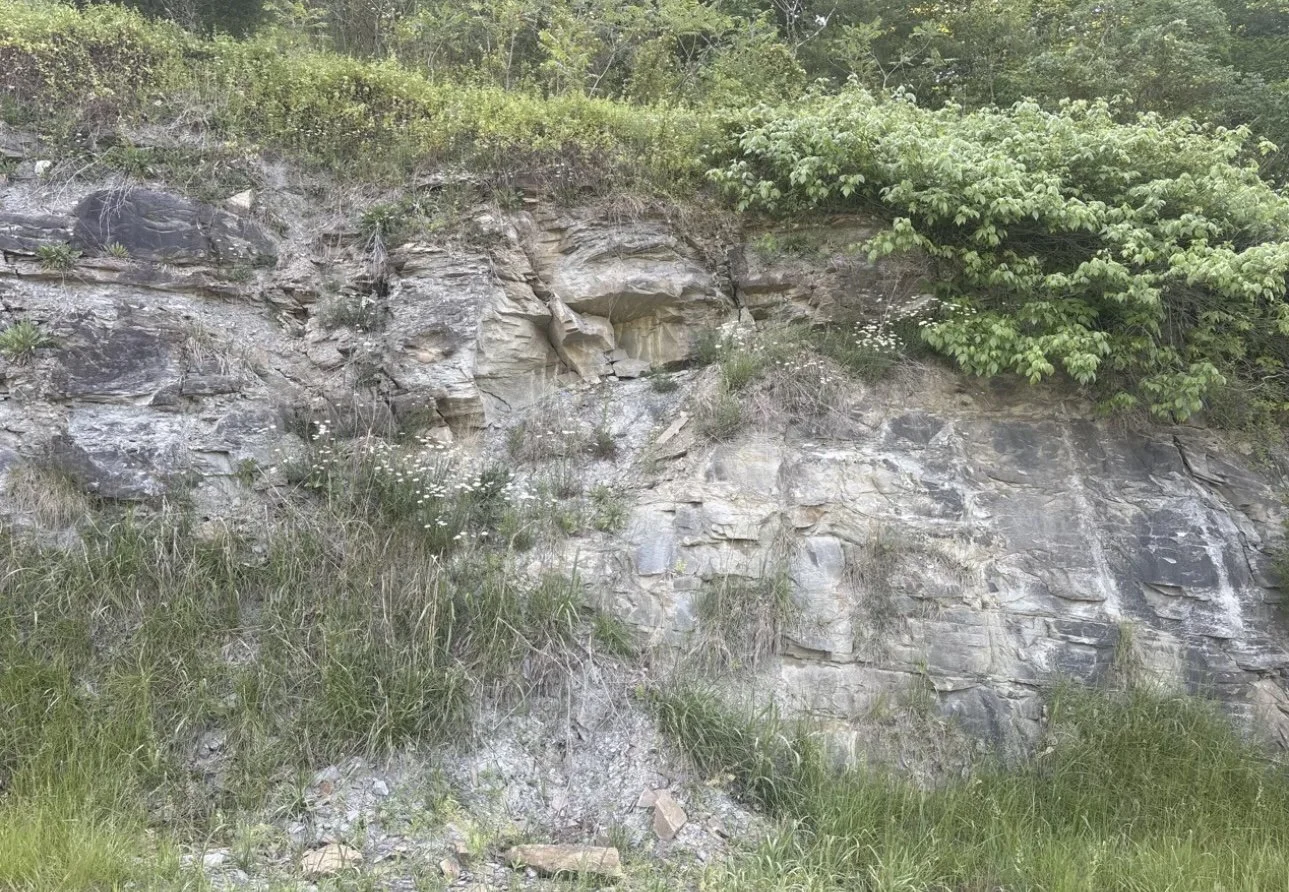
Driving back from a clinic in Tennessee recently, I found myself doing something I’ve actually done on long highway drives for years – looking at the rock faces along the road cuts and wondering about the plants growing out of them. My whole life I’ve noticed these towering walls of stone blasted open by highway construction and somehow, growing out of them, seemingly impossibly, plants. Vines. Wildflowers! How?
I finally decided to research it. And what I found struck me not just because it was fascinating to learn about, but because of the similarities I saw, and the application for so many of us navigating growth through genuinely difficult circumstances.
MORE THEN MEETS THE EYE
What looks like an impenetrable wall from a car window is actually layered sedimentary rock - shale and limestone deposited over centuries in distinct horizontal strata. Those visible layers are natural planes of weakness, places where water can infiltrate. When water enters those hairline fractures between the layers, freezes and expands again and again, it widens the cracks, incrementally, over years and decades. Wind can then deposit fine particles into those spaces: mineral dust, organic matter, fungal spores, and seeds. The crack becomes a crevice. The crevice then becomes, overtime, something that can hold just enough moisture and nutrients to offer the seeds a foothold.
The plants that establish themselves in these conditions are specialists. They are designed for scarcity. Their roots don’t fight the rock, they read it. They follow every available crack and fissure, threading themselves through layers of stone. These roots actually use the rock as a sort of scaffolding or a structure that can support their growth rather than preventing it.
FINDING THE WAY IN
In the Feldenkrais Method, we are often guided to look for where movement is available. If we feel or sense a difficulty or restriction we’re encouraged not to push into it to try and force a change, but to try and see where some movement might be possible, however small and start there. To look for the ease even within the difficulty. To get curious about the hard places rather than feel defeated by them.
These plants were doing exactly the same thing.
When we hit something hard - A plateau maybe in our riding, a fear response that we can’t seem to move past, a part of our body where we are dealing with chronic pain or our movement practice seems to feel stuck, most of us do one of two things. We push harder into the resistance, trying to force our way through. Or we may pull back entirely and avoid the difficulty altogether.
But there is a third option. It requires something more subtle, a new way of approaching difficulty. Staying in contact with the hard thing while remaining sensitive enough to feel where it might possibly yield, in essence finding the crack, the small place where there’s just enough give to begin.
This is easier said than done and requires patience. Especially for riders working to rebuild confidence after a fall or a serious accident. The fear isn’t an enemy to be conquered. It’s the rock face to be read. Where is there just a little more ease available today? Can we start there and trust that the roots can grow even from that small beginning?
THE PATIENCE OF THE SEED
There was another aspect of the research into how these plants seem to grow in these difficult conditions that interested me.
Before we can actually see any visible growth, a seed usually sits dormant for a long time. The conditions for growth are building - a little more organic matter blown in by the wind, a little more moisture from the rain, but nothing visible is happening yet. From the outside, the rock face looks unchanged. But something is happening and at some point quietly, a threshold is crossed and the growth of the plant becomes visible.
Today we live in a time where rapid progress is promised constantly. We’re given quick access to information. So it can be easy to assume that if something isn’t changing quickly or we have a setback that that means growth isn’t happening. Just like that seed though, growth takes time and the right conditions. The seed isn’t failing while it’s waiting. There’s a lot happening behind the scenes before that growth becomes visible.
In the last 6 years of working with people in my practice, I have seen time and again, the ones who experience the most growth and change are the ones who stick with the work. Even in the hard times, when it feels slow, when they feel they have had a setback. Patience, perseverance, and the idea that real mastery requires deliberate practice are what have helped them reach their goals.
It’s not easy, but it is worth it!
“ Don’t judge each day by the harvest you reap, but by the seeds you plant.” - Robert Louis Stevenson
